Recycling Resources
Initiatives for 4 Rs
Our corporate group promotes environment-conscious product design
(3Rs: Reduce, Reuse, and Recycle), such as resource-saving and
plastic-saving products, based on our R&D policy of “Designing
products with low environmental burdens toward a sustainable
society,” aiming to realize a circular economy.
Specifically, we are promoting the following key initiatives under
“Environmentally Friendly Product Design.”
- Reducing and simplifying packaging materials
- Transitioning from single-use to refillable or replaceable designs
- Expanding the use of recycled, biomass, and plant-derived materials (shifting away from fossil-based resources) The following targets are set for “Environmentally Friendly Product Design” (applicable to S.T. products).
- Targets in the fiscal year ending March 2026: 20.5% of qualifying products (bearing the “Minna de Eco” mark)
In the fiscal year ended March 2025, the ratio of qualifying products was 18.8%, with a plan to reach 20.5% by the fiscal year ending March 2026. As a major initiative, for the three SKUs of the “DASHUTAN CHARCOAL” brand, we are working to reduce the amount of plastics used by reviewing the plastic materials used for containers and making them thinner as part of our efforts to reduce the weight and simplicity of containers and packaging.
| Key initiatives for Environmentally Friendly Product Design | Category | Description |
Numerical standards |
Number of qualifying products (SKU) | ||
|---|---|---|---|---|---|---|
| FY 3/24 | FY 3/25 | FY 3/26 | ||||
| Expansion of recycled, biomass, and plant-derived materials |
Raw materials
(components) |
Use of raw materials derived from plants | 50% or more | 0 | 1 | 1 |
| Containers and packaging | Use of recycled materials | 10% or more | 34 | 38 | 39 | |
| Use of raw materials derived from plants | 20% or more | 1 | 1 | 1 | ||
| Lighter and simpler packaging | Reduction of Plastic Usage*1 | 10% or more | 8 | 10 | 13 | |
| Transition from single-use to refillable/replaceable design | Product design | Reduction in Waste (Packaging Weight) through Refill or Replacement | 50% or more | 7 | 15 | 15 |
| Total number of qualifying products (SKU) | 50 | 65 | 69 | |||
| Total number of products (SKU)*2 | 362 | 346 | 337 | |||
| Percentage of qualifying products (%) | 13.8 | 18.8 | 20.5 | |||
*1 Based on our conventional products or representative products
sold concurrently
*2 Aggregated based on consumer products listed in the “Spring
Catalog” for the relevant fiscal year (SKU basis)
Standards for evaluating designs for curbing environmental burdens
Measures with the "Eco for Everyone" Mark
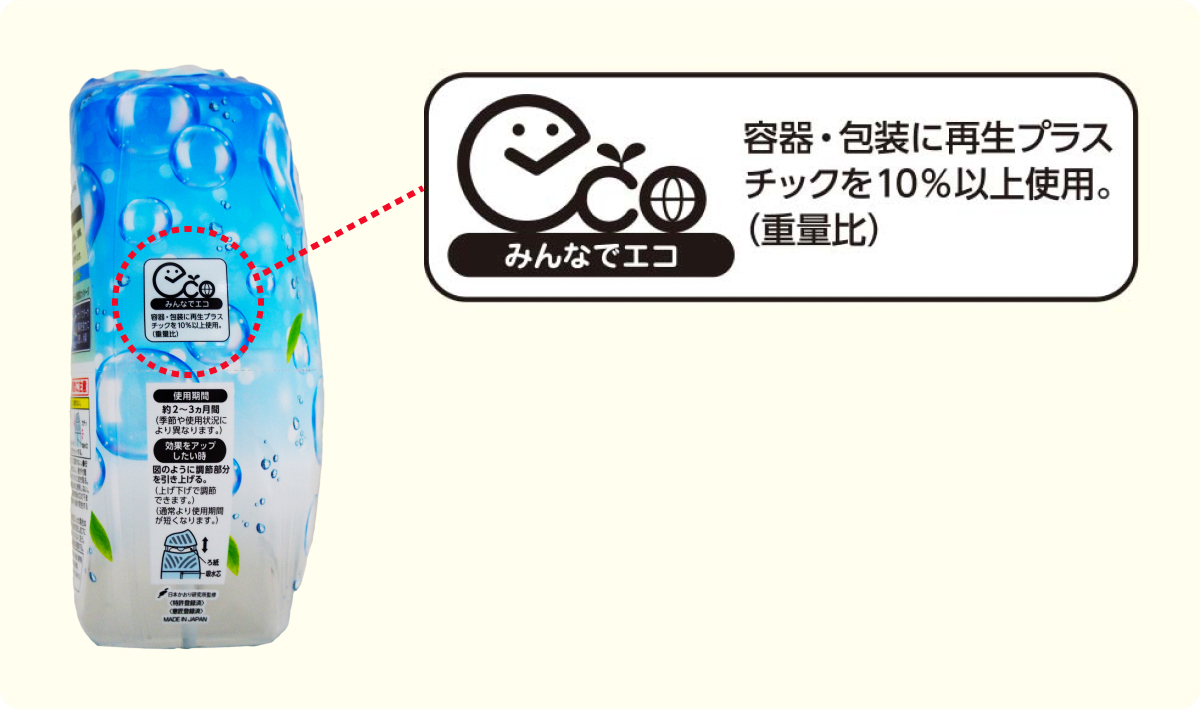
As an indicator of sustainability of containers and packages, the “Eco for everyone” mark is indicated on products that have satisfied our own standards for environmental friendliness, so that customers can understand that our products are environmentally friendly.
Examples of products with the “Eco for everyone” mark
Recycled plastics are used for the bottles of “Shoshu-Riki Deodorizer for Room” and “Shoshu-Riki Deodorizer for Toilet,” with its content being 10% or higher.
S.T. standards for “Eco for everyone” (our original standards)
| Classification | Details | Numerical criteria |
|---|---|---|
| Raw materials (contents) | Use of plant-derived materials | 50% or higher |
| Containers and packaging | Use of recycled materials | 10% or higher |
| Use of plant-derived materials | 20% or higher | |
| Reduction of consumption of plastics* | 10% or higher | |
| Product design | Reduction of waste of refills with respect to main containers and packages (weight of containers and packaging) | 50% or higher |
*compared with that for our existing products or representative products sold together
Lighter and simpler packaging
Reduction of “DASHUTAN CHARCOAL” container plastic weight (plastic usage)
For all products, the container material was changed from PS (polystyrene) to PP (polypropylene), reducing container plastic weight (plastic usage) compared to previous models.
-
For Refrigerators: reduced from 58.58 g to 33.6 g
(42.7% reduction from the previous product) -
For Vegetable Compartments: reduced from 60.18 g to 35.18 g
(41.5% reduction from the previous product) -
For Large Refrigerators: reduced from 86.1 g to 51.51 g
(40.2% reduction from the previous product)

Transition from single-use to refillable/replaceable design
Regarding the "Shoshu-Riki" brand, we have enriched the lineup of refillable and replaceable versions of mainly core products, while reducing the consumption of virgin plastics.
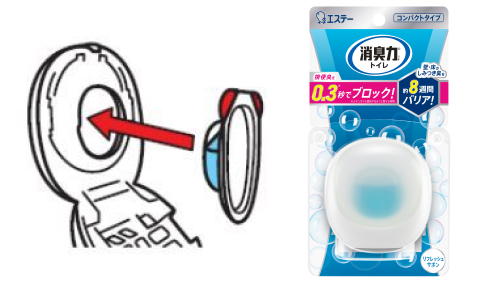
“SHOSHURIKI” COMPACT FOR TOILET
This is replaceable and smaller than conventional products, so the amount of waste has been reduced by 85% (compared to conventional products).
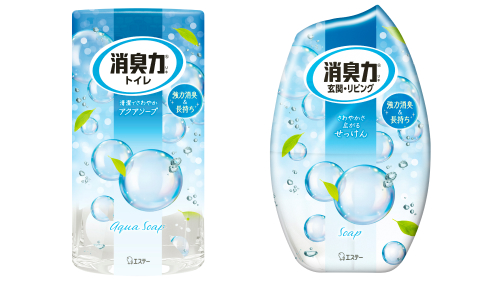
“SHOSHURIKI” FOR TOILET, ENTRANCE & ROOM
The containers of this product are made of recycled plastics and biomass, so the amount of virgin plastics has been reduced.
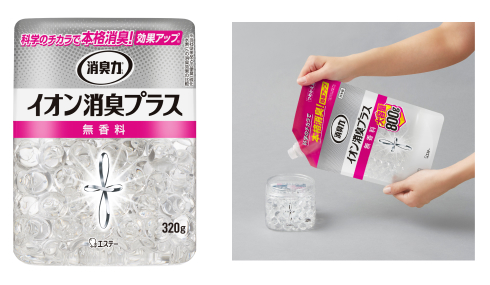
“SHOSHURIKI” ION DEODORANT PLUS
The containers of this product are made of recycled plastics
and biomass, so the amount of virgin plastics has been
reduced.
Through the use of refillable products, the
amount of waste has been reduced by up to 87% (compared with
this product of the same volume).
Waste management
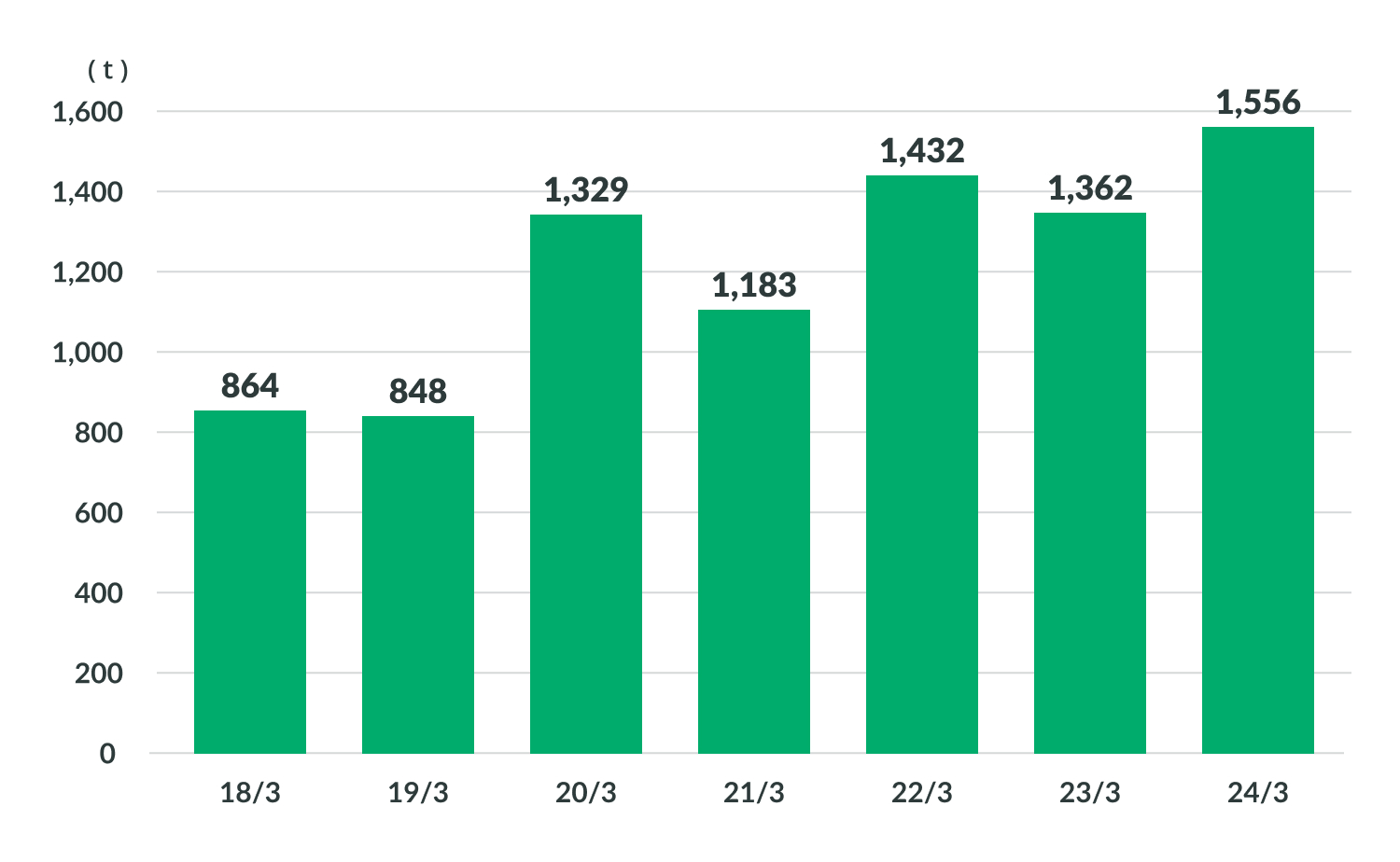
Regarding the management of waste disposal,we regularly check our waste management contractors and comply with laws and regulations to ensure proper disposal. At each of our production sites, we are working to reduce the amount of waste generation through proper management, recycling efforts, etc. The aggregated actual values shown in the graph below include the amount of recyclable materials until FY 3/2024, the values will be recalculated (excluding the amount of recyclable materials) based on a revised calculation method from FY 3/2025.
Total weight of waste
*The subject organization is S.T. Group (domestic).
Our Impact